 heartpact
Long distance workout together: a plan across time zones
How to do a long distance workout together: same move at the same moment or each other's morning, simple time-zone maths, and a week-long plan to try.
A long distance workout together comes down to three small decisions: which move, which moment, and how you'll see each other do it. Pick one exercise you can both do in a bedroom or a hotel room. Agree a time that fits both your days, whether that's the same minute or each of your mornings. Then give each other some way to see the effort, so it feels shared rather than two people exercising alone and reporting back.
That's the whole idea. The rest of this post is how to make it work when the miles, the clocks and the tiredness get in the way.
The quick version
- One move, one number. 20 squats, a 45-second plank, 30 jumping jacks. Small enough to do on a bad day.
- One time each. Either the same moment for both of you, or a set time in each of your mornings.
- One way to see it. A short message, a quick call, or watching the count climb live.
- One kind way out. Agree now what happens on a day one of you can't. No penalties, just a note.
How to do a long distance workout together
Pick a move you can both do anywhere
Distance usually means different spaces. One of you might have a garden; the other might have a narrow bedroom and a neighbour below. Choose moves that need no kit and little room: squats, wall sits, planks, glute bridges, lunges, arm raises. Save burpees and high knees for when you both know the floor can take it.
Keep the numbers honest for both bodies. You don't need the same count. If one of you does 30 squats easily and the other finds 15 hard, set 30 and 15. The point is the same effort at the same time, not the same score. For more moves that fit a small space, see this no-equipment couples workout at home.
Choose: same moment or each other's morning
There are two good ways to share a workout across the miles.
Same moment. You both move at the exact same minute. It feels like being in the room together, and it's lovely when your time zones are close. The cost: when the gap is big, one of you is doing squats at a strange hour.
Each other's morning. You each move at a good time in your own day, say 7:30 for each of you. You're not moving at once, but you're doing the same thing at the same point in your day. It's kinder on sleep and easier to keep going for weeks.
Many couples mix the two: each-other's-morning on weekdays, one same-moment session at the weekend when the clocks are friendlier.
Decide how you'll see it
Seeing your partner try is what turns two solo workouts into one shared one. Options, from lightest to fullest:
- A one-line message when you're done.
- A short voice note with your count.
- A video call while you both move (if your signal is good).
- Watching their count climb live while they do it.
Pick whatever you'll actually keep doing. A message every day beats a call that falls apart by Thursday.
The time-zone maths
Work out the gap once, then write down what each option means in both your days. Here's a planner using rough gaps. Swap in your own times.
| Time difference | Same moment works when | Each other's morning |
|---|---|---|
| 0 to 2 hours | Almost any time: 7:00 for you is 8:00 or 9:00 for them | Easy, and close to the same moment anyway |
| 3 to 5 hours | Your evening and their late afternoon, or your morning and their lunchtime | Good for weekdays, with a shared session at the weekend |
| 6 to 9 hours | Your early morning is their afternoon; one of you gives up a bit of comfort | Usually the better daily choice |
| 10 to 12 hours | Your early morning is their evening, roughly | The most realistic option most days |
A few tips that save arguments:
- Write both times down. "7:00 for me, 15:00 for you." Saying both out loud catches mistakes.
- Watch for clock changes. If either of you has a daylight saving switch, your gap can move by an hour twice a year, and not always on the same weekend. Check the week it happens.
- Protect sleep. If same moment means one of you sets an alarm before 6:00 or moves near midnight, use each-other's-morning instead. Rest matters more than matching.
- Test once. The first time you set something for your partner's day, check together that it went off when you both expected.
Setting dares across the miles
This is where a dare helps. A dare is a promise you both agreed to: one of you picks the move, the count and the time, and the other does it. It gives the workout a moment that belongs to both of you, even from different cities. If you want ideas to start with, try these fitness dares for couples, easy to hard.
In Heartpact, you set your partner a dare, such as 20 squats at 7:00, and at that time their phone rings with a full-screen alarm, over the lock screen. It keeps going until the reps are done (for up to 30 minutes) or until you both agree to end it. They can always silence it on their own phone, and they can send you a note asking to call it off; only you, as the one who set it, can say yes. The phone's camera counts each rep live, and nothing is recorded: no video or photo leaves their phone.
The part that changes things over distance is watching. When your dare rings for your partner, you can watch it happen from wherever you are: a stick figure of their movement and the count climbing. You never see the camera picture, just the movement and the number.
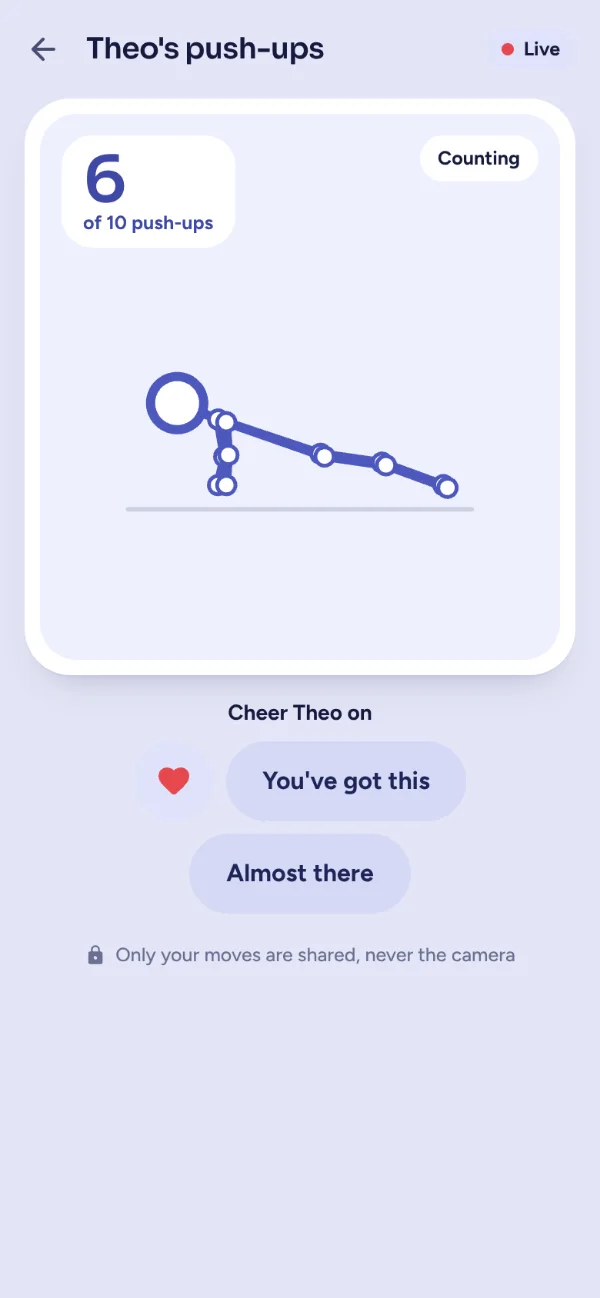
That makes the each-other's-morning option feel shared. You set their dare for 7:30 their time, then watch their count climb from your desk, your commute or your sofa. For a same-moment session, you each set the other a dare for the same minute, and you both move at once. You won't be able to watch while you're doing your own reps, but you'll each see the other's half of the heart go on afterwards.
That heart is the small reward. Each of your finished dares is half a heart; when you both keep your word, it's whole, and streaks count the days in a row. On the free plan you each get one daily dare, which is plenty for this.
Your voice in their ear
When the camera counts, a coach says the count aloud, cheers and gives form tips. On Plus, you can record about a minute of yourself reading lines in the app, and your partner's coach then speaks in your voice. So when their dare rings at 7:30 and you're asleep 8 hours away, it's still you counting them through it.

It's only ever your own voice, recorded live in the app after you agree. Only your partner's coach uses it, and you can delete it any time.
A one-week plan to try
Keep it small. This week is about finding a rhythm, not getting fitter by Sunday.
- Monday: 15 squats each, each in your own morning. Send one line when you're done.
- Tuesday: 30-second plank each. Whoever finishes first watches or waits for the other.
- Wednesday: Rest. Answer a question together instead; here are some questions to ask your partner.
- Thursday: 20 glute bridges, same moment if your gap allows it.
- Friday: 20 jumping jacks, your partner picks the time in your day.
- Saturday: A longer same-moment session: three rounds of squats, lunges and a plank, on a call or as matching dares.
- Sunday: Look back. What time worked? Which move did you both like? Adjust next week.
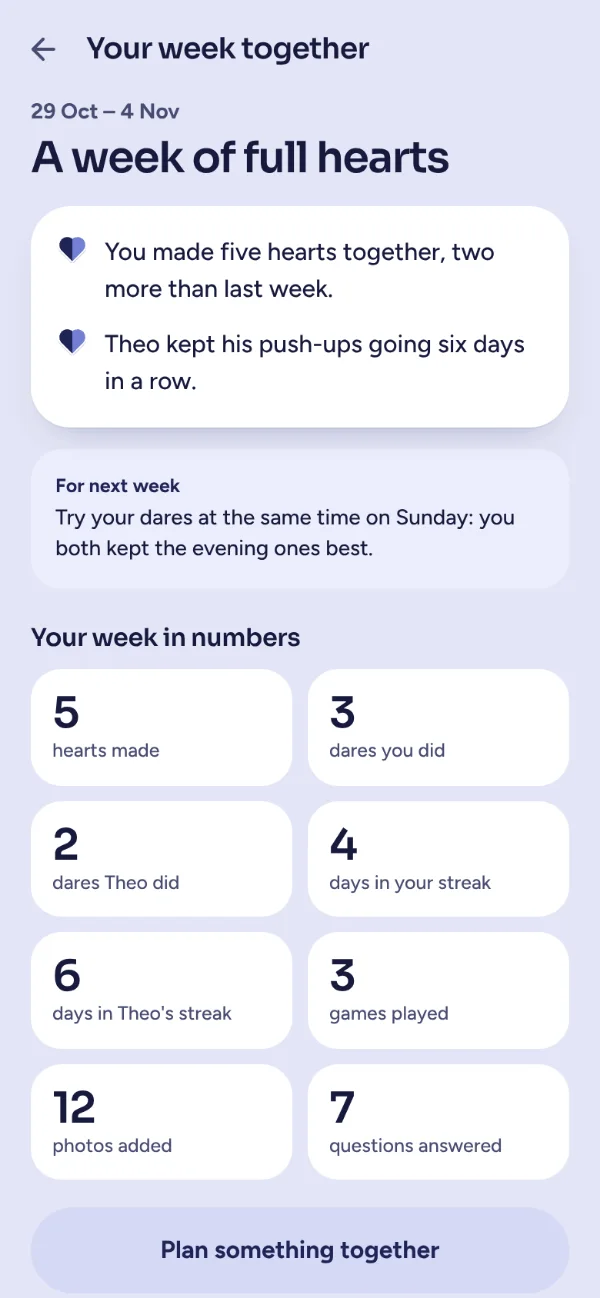
The weekly picture helps here. Heartpact sends a short recap of your week together on Sunday evenings: hearts made, dares, streaks and one suggestion for next week. It's a good thing to read on a call before you plan the week ahead.
If a week goes well and you want something longer, these fitness challenges for couples run over several weeks.
Keeping it kind when the distance is hard
Long distance already asks a lot. A workout should add closeness, not one more thing to feel guilty about.
- Agree the way out first. A late shift, a bad night's sleep, a sad day. One note, no questions, no streak shame.
- Match effort, not numbers. Celebrate the person who did 10 on a hard day as much as 50 on a good one.
- Don't use it to check in on each other. It's a shared habit, not proof of anything.
- Mind your body. If you're injured, unwell or pregnant, check with a doctor or other health professional before starting something new, and swap moves freely.
It also helps to know you're doing something worthwhile. The WHO suggests adults aim for at least 150 minutes of moderate activity across the week, and short sessions all count towards it.
When it stops working
It will, at some point. A new job changes your mornings, a trip changes your time zone, or one of you just loses interest. That's normal. Go back to the three decisions: is the move still right, is the moment still kind to both of you, and do you still like how you see each other do it? Change one thing, not everything, and try another week.
Questions
How can we work out together if we live in different time zones?
Choose between moving at the same moment or at the same point in each of your days, such as 7:30 in each of your mornings. Same moment feels closer but can mean awkward hours when the gap is big. Many couples do each-other's-morning on weekdays and one shared session at the weekend.
What exercises work best for a long distance workout?
Moves that need no kit and little space work best, because your rooms may be very different. Squats, planks, wall sits, glute bridges, lunges and arm raises are good starting points. Set counts that suit each of your bodies rather than forcing the same number.
Do we have to be on a video call to work out together?
No. A one-line message when you finish, a voice note with your count, or watching your partner's count live all work. Pick the option you'll actually keep doing, since a small daily habit lasts longer than a call that's hard to schedule.
Can I see my partner's workout in Heartpact?
If you set the dare, you can watch it live as a stick figure of their movement with the count climbing. You never see the camera picture, and no video or photo of the workout is saved or leaves their phone.
What if one of us misses a day?
Agree before you start that a missed day just needs a short note, with no penalty or guilt. In Heartpact, the person doing the dare can always silence it on their phone or ask the partner who set it to call it off.