 heartpact
Fitness dares for couples: 24 ideas, easy to hard
Fitness dares for couples, sorted easy to hard: 24 exercise dares to give your partner, how to set a fair count and time, and how to let them off kindly.

The best fitness dares for couples are small, specific and agreed in advance: 15 squats at 7:00, a 30-second plank before bed, 10 glute bridges before breakfast. A dare works when it feels like a promise you both made, not a trap one of you set. Below are 24 exercise dares to give your partner, sorted from easy to hard. After the list comes how to pick a fair count and time, and how to let your person off kindly when a day goes sideways.
What makes a good dare
A good fitness dare has four parts. Leave one out and it tends to become either a chore or a fight.
- One exercise. "Do some exercise" is a wish. "20 squats" is a dare.
- A clear count or hold. Reps for moving exercises, seconds for holds like planks and wall sits.
- A time of day. "Sometime today" slides into tomorrow. "At 7:00" happens.
- A kind way out. Before anything starts, agree how either of you can ask to be let off. That one rule keeps a dare a promise rather than a punishment.
Agree the rules together. If one of you sets dares and the other only receives them, it stops feeling like a game. Take turns, or set one each a day.
Fitness dares for couples, from easy to hard
Pick from the level that matches how your partner moves today, not how they moved five years ago or how you wish they moved. Every exercise here can be done in a small room with no kit.
Easy: a warm start
Good for the first week, busy days, or anyone getting back into moving.
- 10 squats while your tea or coffee brews.
- 20 jumping jacks at 7:00, before you look at your phone.
- A 20-second plank before bed.
- 10 arm raises at your desk at midday.
- 10 glute bridges before breakfast.
- 20 high knees after lunch.
- A 20-second wall sit while something heats up.
- Five push-ups at 18:00, knees down if that suits.
Medium: a proper effort
For when easy dares feel too easy and you both want a bit more.
- 25 squats at 7:00.
- A 45-second plank.
- 10 full push-ups.
- 20 lunges, 10 on each leg.
- 30 mountain climbers.
- 15 sit-ups.
- A 30-second side plank on each side.
- A 45-second wall sit.
Hard: save these for good days
These are for partners who already move most days. Use them as a treat, not a daily standard.
- 50 squats in one go.
- A 90-second plank.
- 20 push-ups.
- 15 burpees.
- A 60-second wall sit.
- 40 lunges.
- 50 mountain climbers.
- 30 sit-ups.
If you want longer goals to sit behind these daily dares, our guide to fitness challenges you'll both keep has a few that run over weeks.
How to set a fair count and time
The fairest count is one your partner could manage on a tired day, not their best day. A dare they finish every time builds trust. A dare they fail twice makes them dread the next one.
| Level | Example | Fair count or hold | When it works best |
|---|---|---|---|
| Easy | Squats | 10 to 15 | First thing, before the day gets busy |
| Easy | Plank | 20 seconds | Before bed |
| Medium | Lunges | 20 in total | Lunch break or after work |
| Medium | Wall sit | 45 seconds | While waiting for dinner |
| Hard | Burpees | 15 | A free morning with energy to spare |
| Hard | Push-ups | 20 | A day with no early meeting |
Picking the count
- Ask your partner what feels easy right now, then start a little below it.
- Go up slowly. Add a few reps or 10 seconds at a time, and only after a week of finishing.
- Keep holds short at first. A plank that collapses at 40 seconds is no fun to fail at 60.
- Mix the exercises so the same muscles get a rest the next day.
Picking the time
The time matters as much as the count. A dare that lands in the middle of a meeting, a commute or a child's bedtime is a dare set up to fail.
- Ask for their quiet windows before you set anything.
- Mornings suit people who like it done. Evenings suit people who wake up slowly.
- Avoid straight after a big meal.
- If you live apart or in different time zones, double-check whose 7:00 you mean.
Setting a dare in Heartpact
In Heartpact you set a dare for your partner by picking the exercise, the count or hold time, and the time of day it rings.
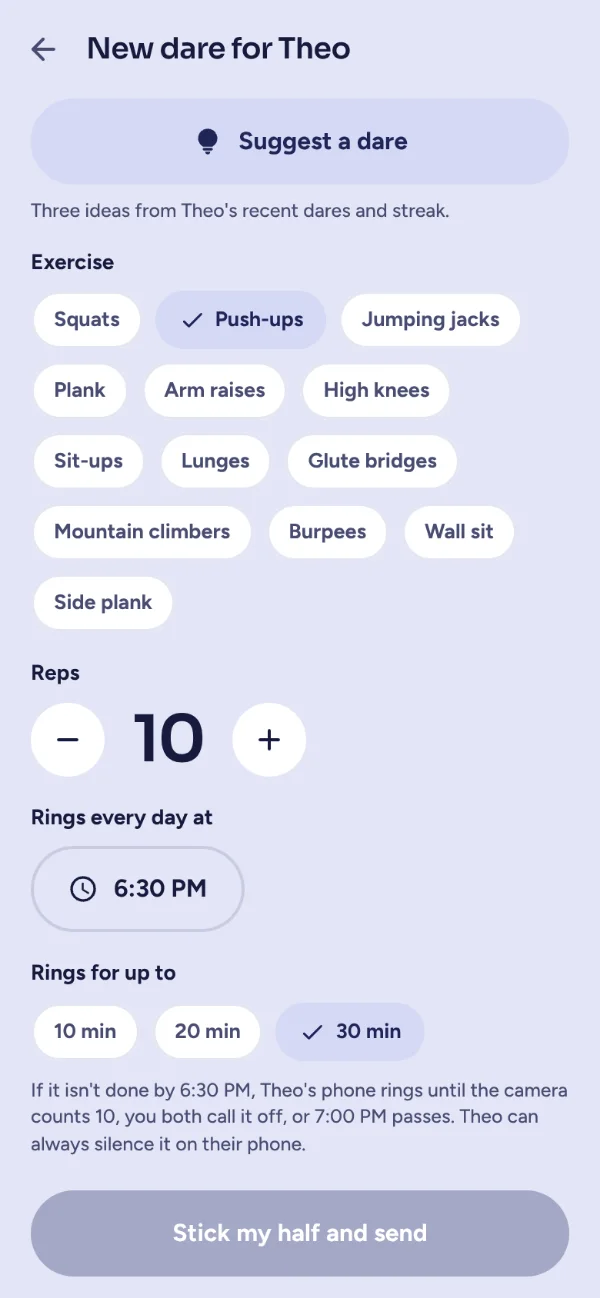
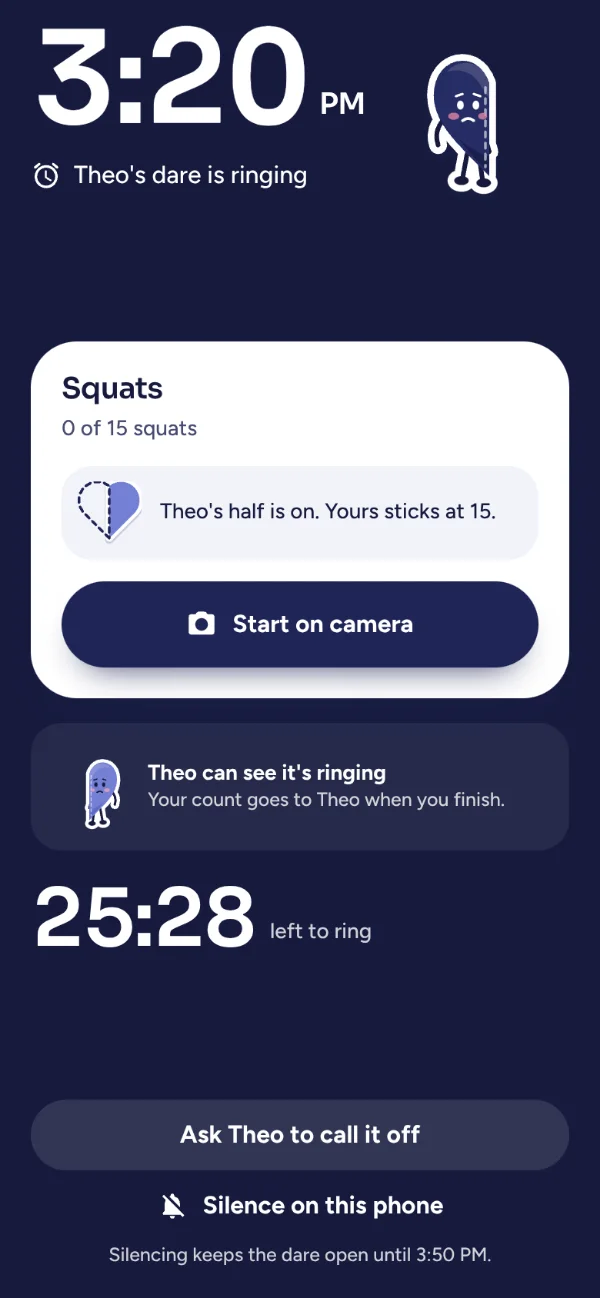
At that time your partner's phone rings with a full-screen alarm, over the lock screen. It keeps going until the reps are done, for up to 30 minutes, or until you both agree to end it.
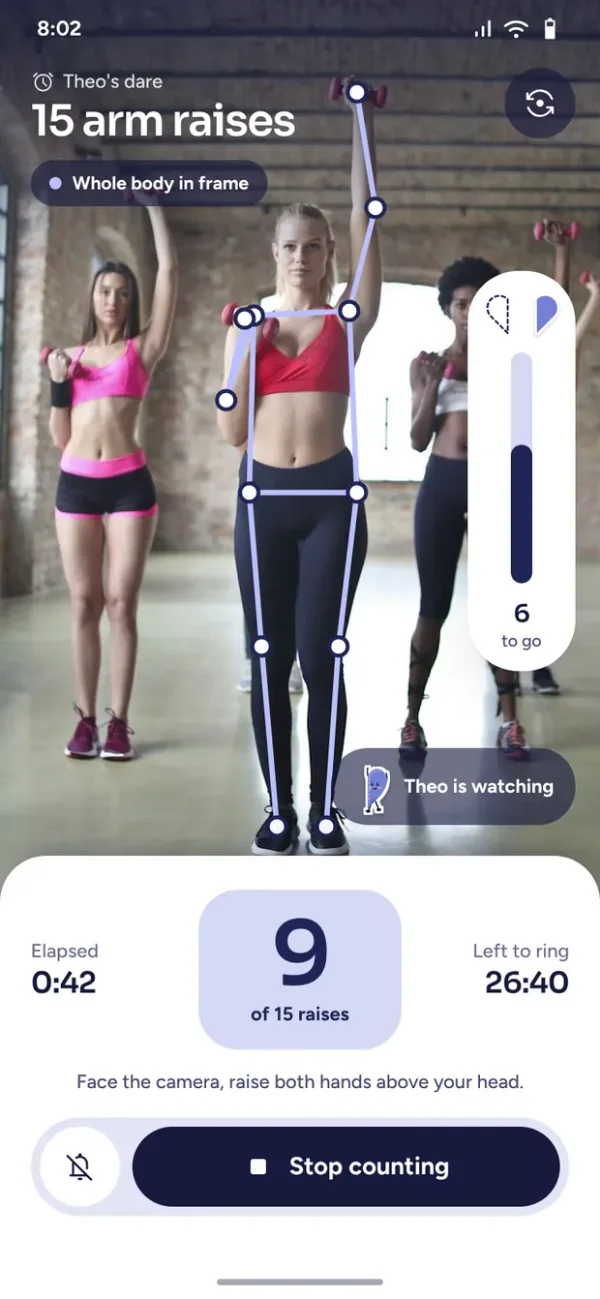
The camera reads their pose and counts each rep live on the phone. A rep with bad form doesn't count, and a short tip says why, such as "Go lower". Nothing is recorded: no video or photo of the workout is saved or leaves the phone. If you set the dare, you can watch it happen as a stick figure and a climbing count, never the camera picture.
How to let someone off kindly
Some days a dare won't happen, and that's fine. Sleep goes badly, work runs late, a knee complains. The point of a dare is that you both want to keep your word, so the way out matters as much as the dare.
Agree the rules before the first dare
- Either of you can ask to be let off, for any reason, without explaining in detail.
- Asking early is better than going quiet.
- No penalties, no extra reps as payback, no teasing about it later.
- A missed day is just a missed day. Start again tomorrow.
What it looks like in practice
If your partner asks off, say yes first and ask questions later, if at all. You could offer a swap instead of a cancel: a 20-second plank instead of 50 squats, or the same dare at 20:00 instead of 7:00. Let them choose. If they'd rather skip, skip.
In Heartpact, the person doing the dare can always silence the alarm on their own phone. They can also ask you to call the dare off with a note, and only the partner who set it can say yes. Treat that note as a kindness to answer quickly, not a request to judge.
Keep it mutual, not one-sided
Dares feel best when you're both in them. Set each other one a day, at similar levels, so neither of you is the coach and neither is the one being drilled.
In Heartpact, each partner's finished dare is half a heart. When you both keep your word, the heart is whole, and your streak counts the days in a row. The Today screen shows who has done theirs. On the free plan you each get one daily dare, which is plenty to start with.
A dare doesn't have to be the whole evening, either. After you've both done yours, pair it with something softer, like one of these questions to ask your partner, or a quick game.
A note on safety
These dares are for people who already feel well enough to move. If your partner is pregnant, injured, recovering from illness or has a health condition, they should check with a doctor or other health professional before trying new exercise. Anyone can stop a dare the moment something hurts, and that's never a broken promise. A good dare respects the body doing it.
Your first week
Start small this week. Each of you pick two easy dares from the list, agree a time that suits the other person, and set the let-off rule out loud. At the end of the week, talk about what felt good and nudge one dare up a level if you both want to. That's the whole system: small promises, kept together, with a kind way out.
Questions
What are good fitness dares for couples who are beginners?
Start with short, simple dares like 10 squats, 20 jumping jacks or a 20-second plank. Choose a count your partner could finish on a tired day. Finishing every time builds confidence, and you can raise the count slowly after a week.
How do you make an exercise dare fair?
Agree the exercise, the count or hold time, and the time of day together before it starts. Pick a time when your partner is free, not mid-commute or mid-meeting. Take turns setting dares so neither of you is always the one being told what to do.
What should happen if my partner doesn't do their dare?
Nothing harsh. A dare is a promise you both agreed to, not a punishment, so a missed day is just a missed day. Agree in advance that either of you can ask to be let off, and start fresh the next day.
Can you do fitness dares with a long-distance partner?
Yes. Set each other dares at times that work in each of your time zones, and check whose clock you mean. In Heartpact the dare rings on your partner's phone wherever they are, and you can watch a stick figure and the count live, never the camera picture.