 heartpact
Fitness challenges for couples: eight you'll both keep
Eight fitness challenges for couples, each with a start level, a weekly step up and a way to keep it fair when one of you is fitter than the other.

Most fitness challenges for couples are set up as a contest. Who can do more push-ups, who lasts longer in a plank, who wins the month. That works for about a week, until one of you is clearly ahead and the other quietly stops. This guide does it differently. Each challenge below is a promise you make to each other, not a race. Each one has a start level, a small step up every week, and a way to make it fair when you are at different levels.
Here is the short version if you only read this screen: pick one challenge, do it at the same time every day, start lower than you think you need to, and add a little each week. Fair means the same effort, not the same number.
How to make it fair when you're at different levels
Couples rarely start at the same fitness. One of you runs, one of you hasn't exercised in a year. That's fine. You just need a rule that makes the effort match, even when the numbers don't. Pick one of these before you start.
- Half your own best. Each of you tests once: as many good reps as you can in one minute. Your daily target is half of your own number. If your partner manages 30 squats and you manage 16, they start at 15 and you start at eight.
- Same time, different move. You both hold for 30 seconds, but one does a plank on the knees and the other on the toes. The clock is shared; the version is your own.
- Same step, different start. You each start where you are, and you both add the same small amount each week. Nobody catches up, and nobody needs to.
- The kind way out. Agree now what happens on a bad day: a sick day, a sore knee, a long shift. A promise you both agreed to should never feel like a punishment. Skipping with a note is better than stopping for good.
Eight fitness challenges for couples to try this month
Every challenge here is bodyweight only, takes under 10 minutes and can be done in a living room. Do one a day, at a set time, and step up once a week.
1. The morning squat promise
- Start: 15 squats each, or half your one-minute best.
- Weekly step up: add five.
- Fair version: the half-your-best rule. If squats are hard on your knees, squat to a chair and stand back up.
Squats are the easiest place to begin because almost everyone can do some. Set a time you're both awake, such as 7:00, and do them before coffee.
2. The plank ladder
- Start: a 20-second plank.
- Weekly step up: add 10 seconds.
- Fair version: same clock, different plank. Knees down or toes, whichever lets you hold good form for the full time.
By week four you're at 50 seconds. That sounds small. It doesn't feel small.
3. The push-up pact
- Start: five push-ups each.
- Weekly step up: add two.
- Fair version: pick your level. Push-ups against a wall, on your knees, or full. Move up a level when you can do the target easily.
4. The wall sit, side by side
- Start: 30 seconds.
- Weekly step up: add 10 seconds.
- Fair version: same time, different depth. Thighs level with the floor is the full version; higher up is still a wall sit.
This one is good for doing in the same room. Sit against the same wall, start the timer together and talk to get through it.
5. Lunges and bridges
- Start: 10 lunges (five each leg) and 10 glute bridges.
- Weekly step up: add two of each.
- Fair version: hold a door frame or chair back for balance on the lunges if you need it.
6. The wake-up jacks
- Start: 30 jumping jacks.
- Weekly step up: add 10.
- Fair version: step jacks (step one foot out at a time, no jump) if jumping isn't comfortable or the neighbours are downstairs.
7. The core pair
- Start: 10 sit-ups and a 15-second side plank on each side.
- Weekly step up: add three sit-ups and five seconds.
- Fair version: side plank with the bottom knee down.
8. The burpee finish
- Start: three burpees.
- Weekly step up: add one.
- Fair version: step back into the plank instead of jumping, and skip the jump at the top.
Burpees are the hardest move here. Save this one for when one of the easier challenges has become a habit.
A four-week plan you can copy
If you'd rather not choose, rotate three challenges through the week. Here is what the numbers look like for the full versions. Scale them with your fair rule.
| Week | Squats | Plank | Push-ups | Wall sit |
|---|---|---|---|---|
| 1 | 15 | 20 seconds | 5 | 30 seconds |
| 2 | 20 | 30 seconds | 7 | 40 seconds |
| 3 | 25 | 40 seconds | 9 | 50 seconds |
| 4 | 30 | 50 seconds | 11 | 60 seconds |
Turning a challenge into a promise
The hard part of any challenge isn't the reps. It's day nine, when it's raining, you're tired and nobody would know if you skipped. Two things help: a fixed time, and someone who's expecting you to do it. Your partner is the obvious someone.
You can do this with a phone alarm and a message saying "done". Heartpact is built for exactly this, if you want it to do the remembering. You set your partner a dare, such as 20 squats at 7:00, and they set you one.
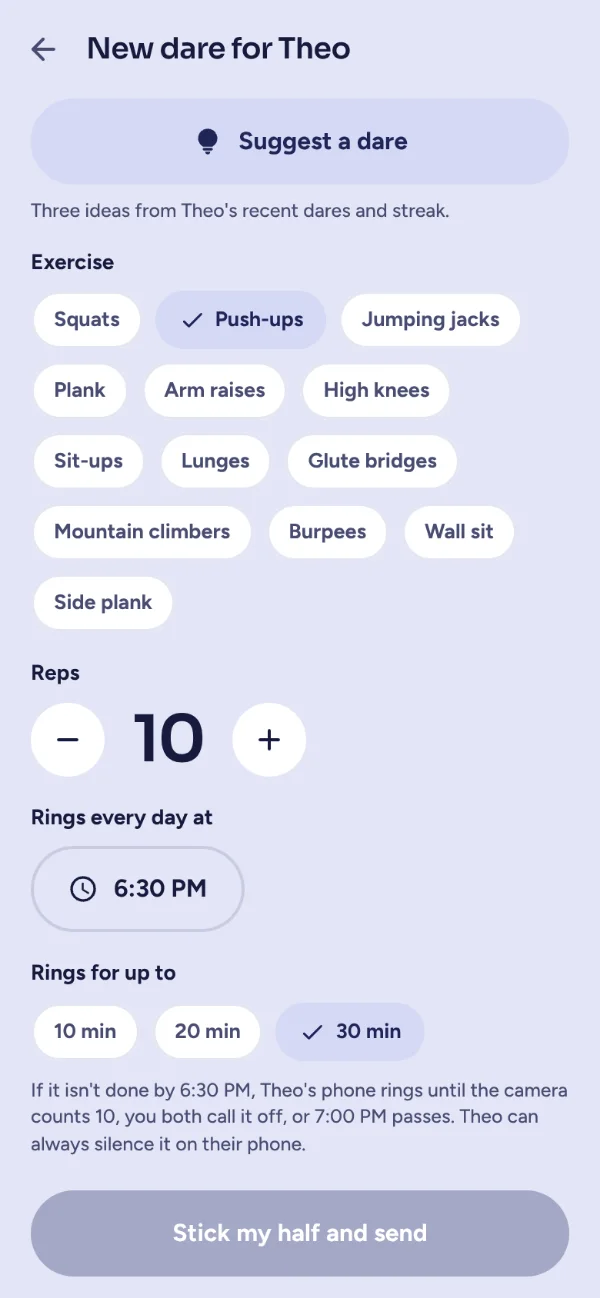
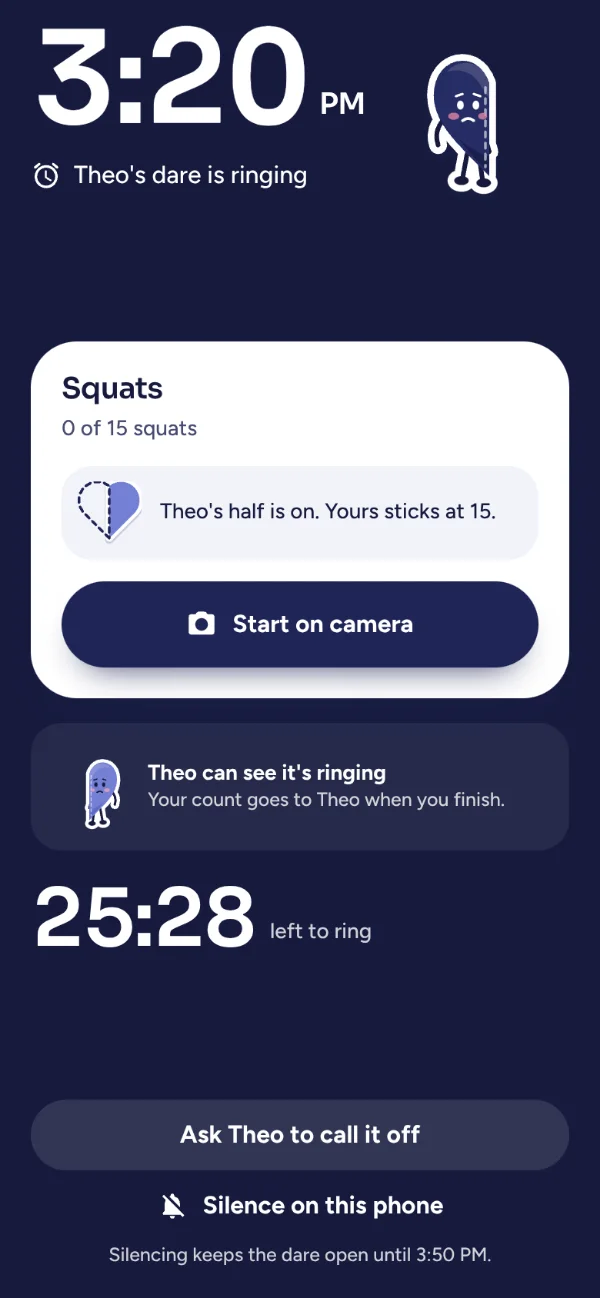
At that time their phone rings with a full-screen alarm, over the lock screen. It keeps going until the reps are done, for up to 30 minutes, or until you both agree to end it. They can always silence it on their own phone, and they can ask you to call the dare off with a note. Only the partner who set it can say yes. That's the kind way out, built in.
Why the camera makes it fair
The phone's camera reads your pose and counts each rep live. A rep with poor form doesn't count, and a short tip says why, such as "Go lower". That matters for the fair rules above: it isn't about who's stronger, it's about whether each of you did what you promised, properly. Surprise check-ins ("Freeze!") make sure it's really you, live.
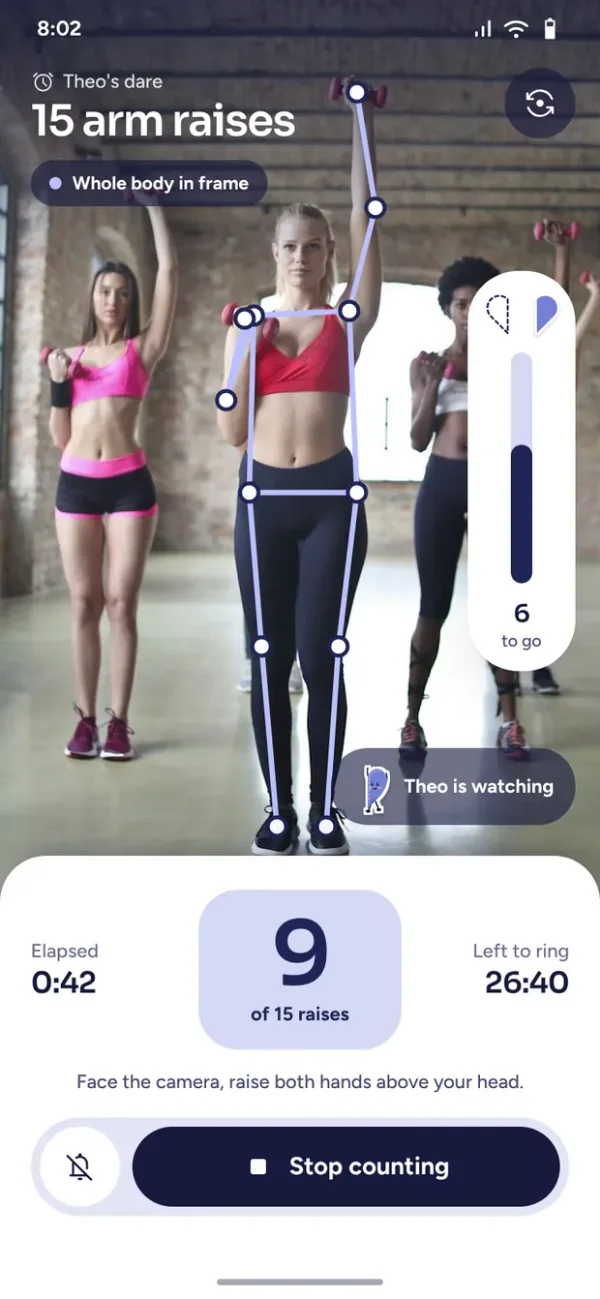
On privacy: nothing is recorded. No video or photo of the workout is saved or leaves the phone. If your partner set the dare, they can watch it happen, but what they see is a stick figure of the movement and the count climbing, never the camera picture.
Each done dare is half a heart. When you both keep your word, the heart is whole, and streaks count the days in a row. That's the opposite of a contest: you only fill the heart together. The free plan gives each of you one daily dare, which is all you need for one challenge a day.
When to ease off
A good challenge bends around real life. Step back a level, or pause, when:
- one of you is ill, injured or recovering from something;
- a move causes pain rather than effort (pain is a reason to stop, not push through);
- you're pregnant or have a health condition, in which case check with a doctor, midwife or other health professional before starting or stepping up;
- life is simply full that week. Repeat the previous week's numbers instead of adding more.
Repeating a week isn't failing. It's the plan working.
Keeping it going past week four
Most challenges stall when the novelty wears off. A few small changes keep them fresh without making them harder too quickly.
- Swap the move, keep the time. Same 7:00 slot, a new exercise each month. The habit is the time, not the squat.
- Let your partner choose. Each Sunday, you pick your partner's challenge for the week and they pick yours. It's a small gift, and it keeps things varied.
- Set a shared finish line. "A full month of whole hearts" or "a 60-second plank each by the end of the month" gives you both the same goal from different starting points.
- Reward the streak, not the score. A cheap treat, a film night, a walk somewhere new. Celebrate showing up, never the size of anyone's number.
- Get ideas when you're stuck. In Heartpact, "Suggest a dare" offers ideas, and a short coach's note after a finished dare is a nice nudge. You can see how dares work on the Heartpact home page.
The best challenge is the one you're both still doing in two months. Start small, keep it fair, and keep your word to each other.
Questions
What is a good fitness challenge for couples who are beginners?
Start with a daily squat or plank challenge at a fixed time. Begin at 15 squats or a 20-second plank and add a little each week. Both are simple, need no equipment and are easy to scale to each person's level.
How do you make a couples fitness challenge fair if one partner is fitter?
Match effort, not numbers. Each of you can aim for half of your own one-minute best, or hold for the same time using an easier or harder version of the move. Then add the same small amount each week.
How long should a couples fitness challenge last?
Four weeks is a good first block, with a small step up each week. After that, keep the same daily time and swap in a new exercise so the habit continues without getting stale.
What should we do if one of us misses a day?
Agree a kind way out before you start, such as skipping with a note on sick or very busy days. Pick up again the next day at the same level rather than doubling up. If pain or a health issue is the reason, check with a health professional before carrying on.