 heartpact
Couples workout at home, no equipment: a 20-minute plan
A 20-minute couples workout at home with no equipment: five bodyweight moves, each with an easier and a harder version, so you both finish together.
If you want a couples workout at home with no equipment, here it is: 20 minutes, five bodyweight moves, three rounds. Squats, push-ups, planks, lunges and glute bridges, done side by side for 40 seconds each with 20 seconds to breathe. Every move has an easier and a harder version, so you can work at different levels and still start and stop on the same beep. All you need is a bit of floor, a timer and your person.
The trick that makes it work for two is simple. You share the clock, not the numbers. Nobody finishes early and waits, and nobody gets left behind.
The 20-minute couples workout at home, no equipment
Here's the whole session at a glance:
- Warm-up: three minutes of easy movement.
- Main block: three rounds of five moves, 40 seconds on and 20 seconds off. That's five minutes a round, 15 minutes in total.
- Cool-down: two minutes of slow stretching.
Set one timer for both of you, on a phone propped where you can both see it. Stand or kneel side by side, or face each other if your space allows. Pick your version of each move before you start, and change it between rounds if it's too easy or too hard.
| Move | Easier version | Harder version | What to watch |
|---|---|---|---|
| Squats | Sit to a chair and stand | Pause for two seconds at the bottom | Knees track over toes, chest up |
| Push-ups | Hands on a wall or worktop | Feet on the floor, slow down for three counts | Body in one straight line |
| Plank | On knees and forearms | On hands and toes, lift one foot at a time | Hips level, no sagging |
| Lunges | Hold a wall, shorter step | Alternate legs without pausing | Front knee over ankle |
| Glute bridges | Both feet down, small lift | One leg lifted, then switch | Squeeze at the top, ribs down |
Rest for a full minute between rounds if you need it. The routine then runs a little over 20 minutes, which is fine.
Why a timer beats a rep count for two people
If you both agree to do 20 push-ups, the stronger partner finishes first and stands around. The other one rushes, form goes, and the whole thing starts to feel like a race nobody asked for.
With 40 seconds on the clock, you're both working for the same stretch of time. One of you might do 25 squats with a pause and the other 12 to a chair. You both did the work, and you both stop together. That's the point.
It also gives you something to talk about afterwards that isn't who won. Try asking each other which round felt best, or which move you'd change next time.
Easier and harder versions of each move
Start with the easier version if you're not sure. You can move up mid-session; moving down mid-set when you're tired is just as smart.
Squats
Stand with feet about shoulder-width apart. Push your hips back as if sitting into a chair, then stand up tall.
- Easier: squat down until you touch a real chair, then stand. The chair tells you how low to go.
- Harder: hold the bottom for two seconds before you rise, or add a small jump at the top if your knees and floor are happy with it.
Push-ups
Hands a little wider than your shoulders, body straight from head to heels.
- Easier: wall push-ups, or hands on a kitchen worktop or sturdy table. The higher your hands, the easier it is. Knee push-ups sit between the two.
- Harder: full push-ups, lowering slowly for a count of three. If that's comfortable, pause just above the floor.
Planks
Forearms under shoulders, body in a line, breathing steadily.
- Easier: knees down, hips in line with your shoulders. Hold for as much of the 40 seconds as you can, then rest and go again.
- Harder: a high plank on hands and toes, lifting one foot a few centimetres, then the other. Or face your partner and tap hands, alternating sides, without letting your hips rock.
Lunges
Step one foot back, lower until both knees are bent, then return to standing.
- Easier: hold a wall or chair back for balance, and take a shorter step. Do all your reps on one leg for 20 seconds, then switch.
- Harder: alternate legs with no pause between, keeping your chest up.
Glute bridges
Lie on your back, knees bent, feet flat. Press through your heels to lift your hips, then lower slowly.
- Easier: smaller lifts, lowering all the way down each time.
- Harder: single-leg bridges, 20 seconds on each side, with a one-second squeeze at the top.
Warm-up and cool-down
Three-minute warm-up
Do each for 30 seconds, together:
- March on the spot, swinging your arms.
- Big arm circles, forwards then backwards.
- Slow bodyweight squats, half depth.
- Hip circles, hands on hips.
- Step back into gentle lunges, alternating.
- Shoulder rolls and a few deep breaths.
Two-minute cool-down
Hold each stretch for about 30 seconds, breathing out slowly: a standing quad stretch (hold your partner's shoulder for balance), a hamstring stretch with one heel forward, a chest stretch with hands clasped behind you, and a child's pose on the floor. It's a good moment to say one thing your partner did well.
Small ways to make it feel like a two-person workout
You can do this routine next to a stranger at a gym. These touches make it yours:
- Face each other for squats and lunges, so you can mirror the pace.
- Take turns choosing the music, one session each.
- One person calls the switch each round, so you're not both staring at the timer.
- High-five between rounds. It sounds silly. It helps.
- Swap a form cue, not a critique. "Chest up" is helpful. A running commentary isn't.
- Let the fitter partner pick harder versions rather than more rounds, so you still finish at the same time.
If you'd like ways to raise the stakes a little, our list of fitness dares for couples runs from gentle to tough, and every one has a kind way out.
Keep it going through the week
The hard part isn't the 20 minutes. It's starting on the third day, when the sofa looks nicer. Two things help: a fixed time, and a promise to someone other than yourself.
Pick three days that fit both your weeks, say Monday, Wednesday and Saturday, and a time you can both keep. Put it in both your calendars. If one of you can't make it, the other still does the session, and you catch up on a short version later.
On the days in between, a small daily dare keeps the habit warm without a full session. This is where Heartpact helps. You set your partner a dare, like 20 squats at 7:00 or a 60-second plank, and they set you one back.
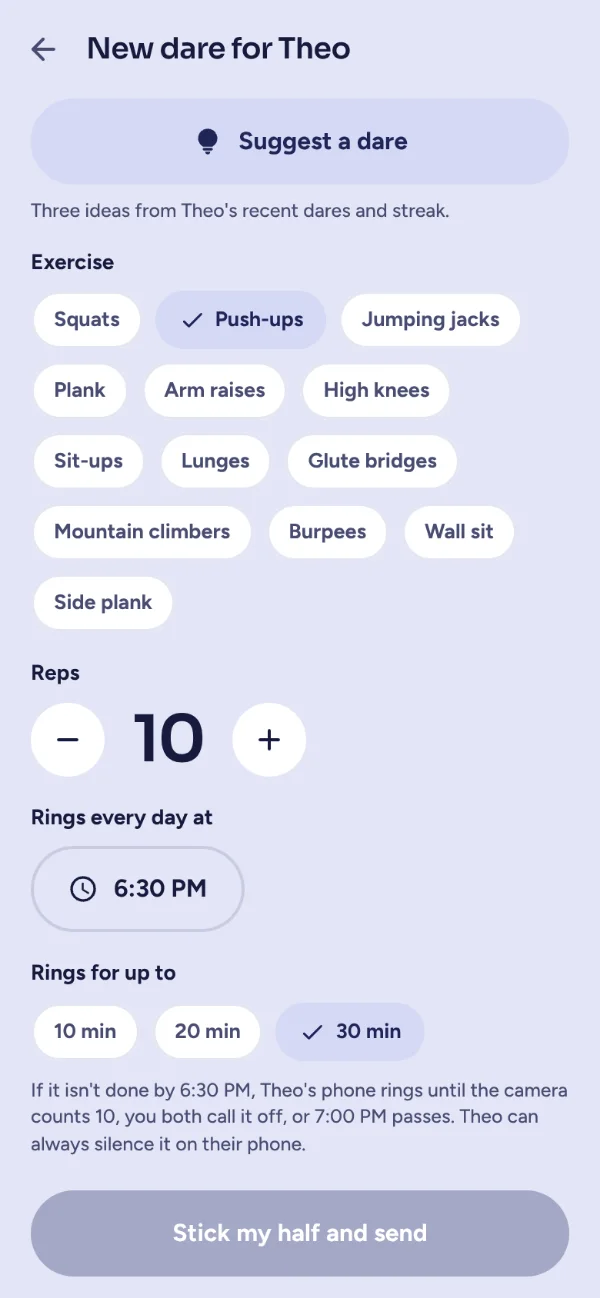
At that time, their phone rings with a full-screen alarm, even over the lock screen, until the reps are done (for up to 30 minutes) or you both agree to end it. They can always silence it on their own phone, or send you a note asking to call it off; it's your yes to give. The camera reads their pose and counts each rep live on the phone. A squat that's too shallow doesn't count, and a short tip like "Go lower" says why. Nothing is recorded, and no video or photo leaves the phone.
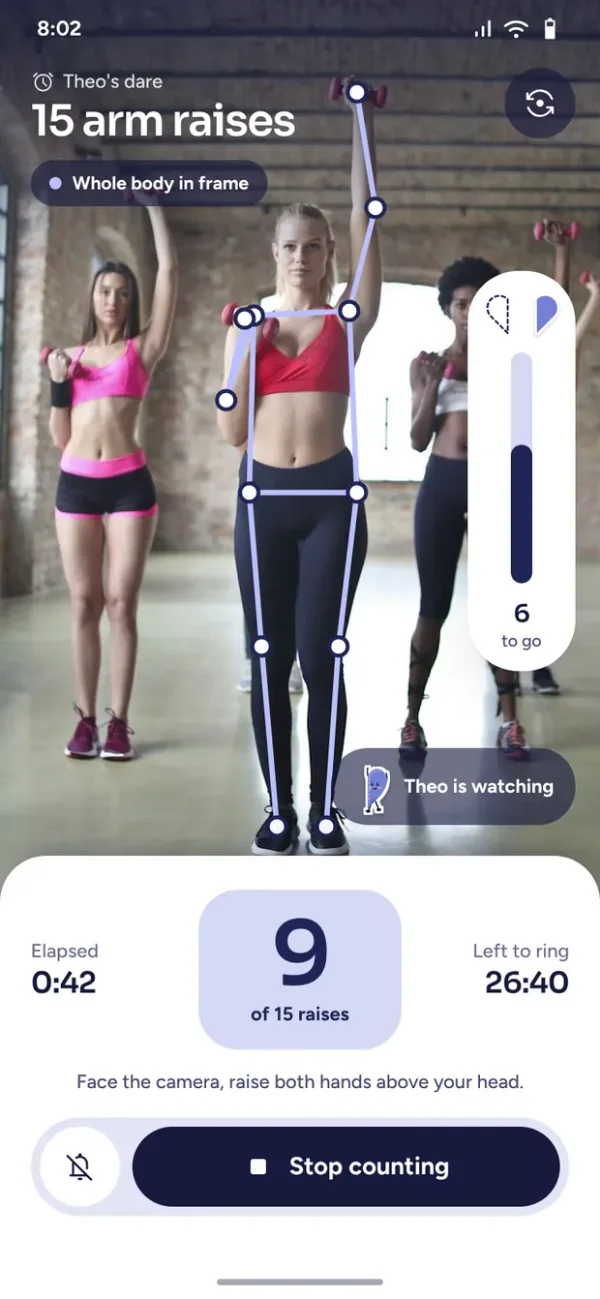
All five moves in this routine are ones the camera can count: squats, push-ups, planks, lunges and glute bridges. When you've both done your dare, your two halves make a whole heart, and the streak counts the days in a row. The free plan gives you one daily dare each, which is plenty for the days between sessions.
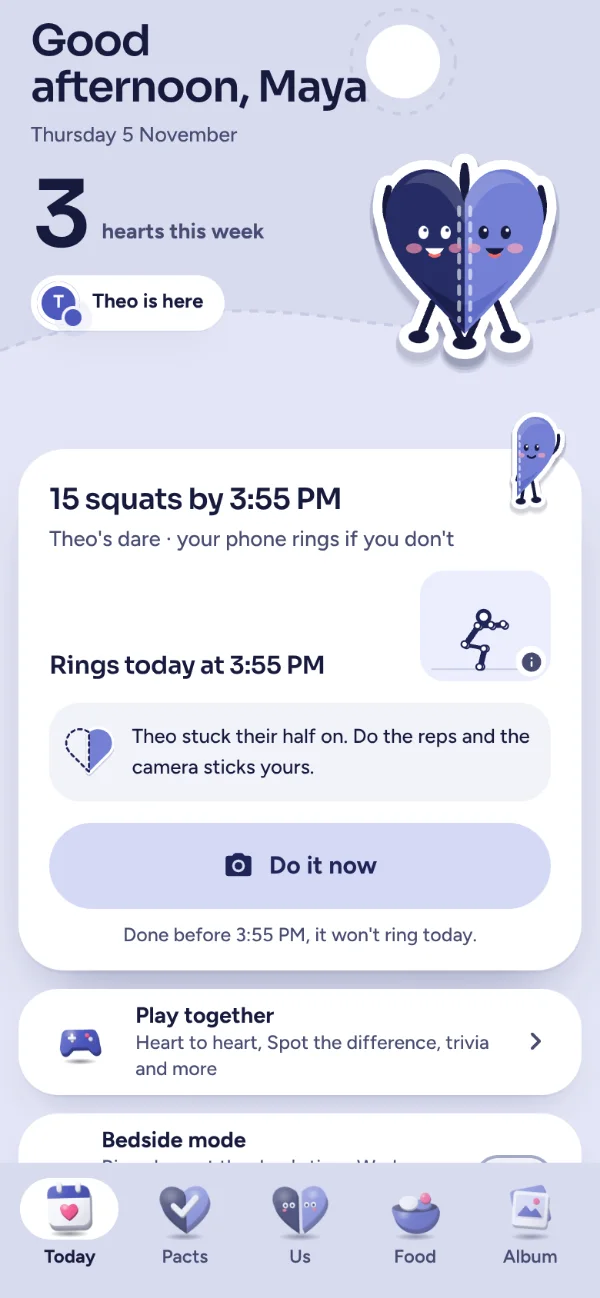
You don't need an app to do any of this, of course. A shared calendar and a text saying "done" work too. The dare just makes the promise ring at the right moment. For longer goals you can work towards over a month, try one of these fitness challenges for couples.
When to take it easy
This routine is moderate, but it isn't for everyone on every day. If you're pregnant, recovering from an injury or illness, have a health condition, or are coming back after a long break, check with a doctor, physiotherapist or other health professional before you start. Stop any move that causes sharp pain, dizziness or chest discomfort.
For context, the World Health Organization's guidance on physical activity suggests adults do muscle-strengthening activity on two or more days a week, alongside regular moderate activity. Three of these sessions a week covers the strength part, and a walk together on other days adds the rest.
And be kind to each other. Some days one of you will do the harder versions and the other will do half the rounds. Both count. The aim is to keep turning up together, not to keep score.
Questions
Can a 20-minute bodyweight workout really make a difference?
Yes, if you do it regularly. Moves like squats, push-ups and lunges work your main muscle groups, and the harder versions keep them challenging as you get stronger. Doing it two or three times a week is what makes the difference.
What if one of us is much fitter than the other?
Work to the same timer and choose different versions of each move. The fitter partner does the harder version, the other does the easier one, and you both start and stop together. Nobody waits around and nobody rushes.
How often should couples do a home workout like this?
Two or three times a week, with a rest day between, is a good start. On the days in between, a short walk or a single small dare keeps the habit going. If anything hurts or you have a health condition, check with a health professional first.
Do we need a mat or anything else?
No. A carpet, rug or folded towel is enough for planks and glute bridges, and a sturdy chair or wall helps with the easier versions. A phone timer you can both see is the only other thing you need.