 heartpact
Accountability partner for fitness: set the rules together
Your partner can be the best accountability partner for fitness. How to set the rules together, keep each other going and stay kind when someone slips.

An accountability partner for fitness is someone who knows what you said you'd do and notices whether you did it. The best one may already be beside you: the person you live with or love. They see your mornings and they know your favourite excuses. They also care how you feel, not just whether you moved.
Here is the short version. Agree one small promise each. Set the rules together, including what happens on a bad day. Check in at a fixed time, not whenever one of you remembers. When someone slips, ask before you judge, and start again tomorrow.
The rest of this post shows how to do each step this week.
Why your partner makes a good accountability partner for fitness
A gym buddy or a friend from work can help. A partner has a few advantages that are hard to match.
They're already there
You don't need to book a time or send a reminder to someone across town. Your partner is at breakfast, on the sofa, or a message away. Short, frequent check-ins are easy when you already share a day.
They know the real reasons
A friend sees that you missed a session. Your partner knows you slept badly, had a hard call with your family or worked late. That context lets them push when you need a push and back off when you need rest.
It goes both ways
The strongest setups are mutual. You each make a promise, and you each keep an eye on the other's. Nobody is the coach and nobody is the student. That balance stops it feeling like one person is being managed.
The risk to watch
The same closeness can make it personal. A comment about a skipped workout can land as a comment about you, your body or your relationship. That's why the rules matter, and why you set them together.
Set the rules together in one short talk
Sit down for 20 minutes, phones away. Go through these questions and write the answers somewhere you'll both see.
- What is each of you promising? One clear thing each, such as "20 squats every weekday" or "a 60-second plank before bed".
- When? A fixed time beats "sometime today". 7:00 before work, or 18:30 when you get home.
- What counts as done? All the reps, or most of them? Agree now so you never argue about it later.
- How will you check in? A word at dinner, a message, or something that does it for you.
- What happens on a missed day? Decide the kind response in advance. More on this below.
- What stays private? Some people are happy to share weight or measurements; many aren't. You can keep this entirely about showing up.
- When will you review it? Pick one evening a week to ask how it's going.
Here's one way a couple might fill it in:
| Rule | Example | Why it helps |
|---|---|---|
| The promise | 15 squats each, weekdays | Small enough to do on a bad day |
| The time | 7:00 for one, 19:00 for the other | Fits two different routines |
| Done means | Every rep, good form | No debates later |
| Check-in | A quick "done" by 21:00 | One touchpoint, not constant reminders |
| Missed day | Ask "what got in the way?" and restart tomorrow | Keeps it kind |
| Review | Sunday evening, 10 minutes | Adjust before anyone gives up |
If you're not sure what to promise, our list of fitness dares for couples, from easy to hard has plenty of starting points.
Start smaller than feels useful
The most common mistake is an ambitious first week. You both feel motivated, you agree to an hour a day, and by Thursday one of you is behind and feeling guilty.
Start with something that takes under five minutes. Ten push-ups. A 30-second wall sit. Two minutes of jumping jacks. The point of the first fortnight is to build the habit of showing up for each other, not to get fit fast. Once that feels easy, add a little.
If you want something longer for weekends, try a 20-minute couples workout at home with no equipment and keep the weekday promise short.
If either of you is pregnant, injured, recovering from illness or new to exercise after a long break, check with a doctor or other health professional before you choose your promise.
Check-ins that don't feel like nagging
Nagging happens when one person has to remember for both and then has to bring it up. The fix is to move the reminder out of your partner's mouth and into something you both agreed to.
A few ways to do that:
- A shared time. If you both exercise at 7:00, there's nothing to ask.
- A single word. "Done" in a message, and nothing more is needed.
- Let something else ring. An alarm you agreed to is a reminder neither of you has to give.
That last one is what Heartpact is built around. One partner sets the other a dare: the exercise, the count and the time, for example 15 squats at 7:00.
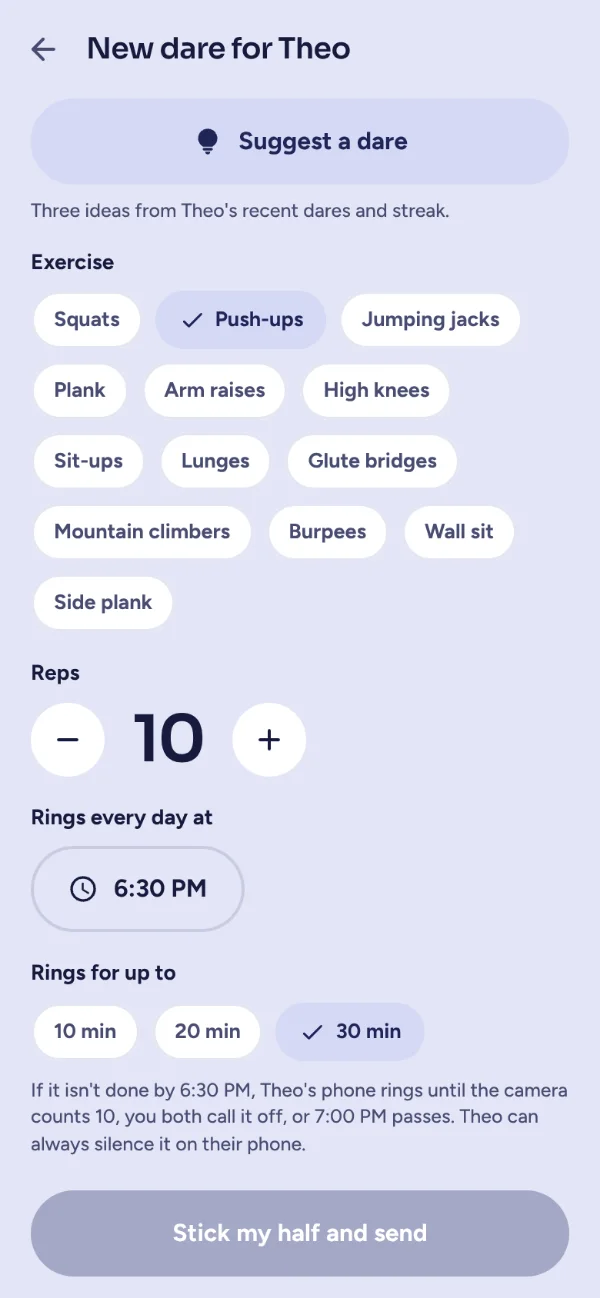
At that time your phone rings with a full-screen alarm, over the lock screen. It keeps going until the reps are done (the phone's camera counts them live, and nothing is recorded), for up to 30 minutes, or until you both agree to end it. You can always silence it on your own phone.
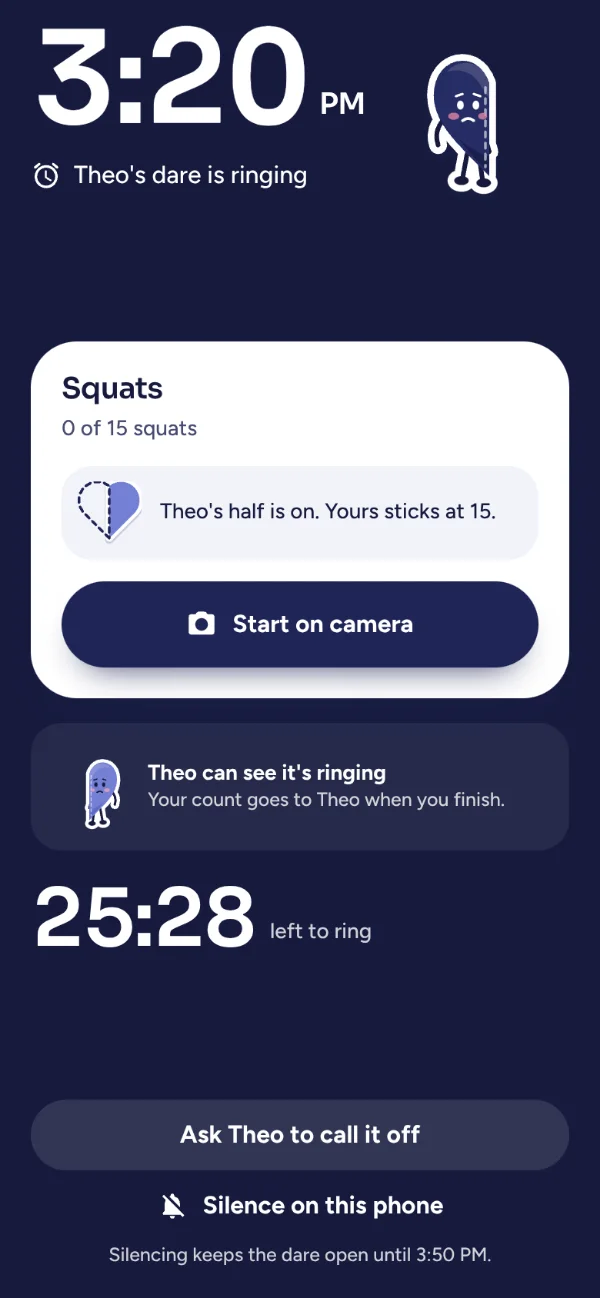
So the reminder isn't your partner chasing you. It's a promise you both set up, arriving on time. On the free plan, each of you gets one daily dare, which is plenty for a small first promise.
When someone slips, stay kind
Someone will miss a day. Probably both of you, more than once. How you handle that decides whether the whole thing lasts.
Ask before you assume
"What got in the way?" is a better opening than "You didn't do it". Often the answer is something real: a headache, a late shift, a bad night. Sometimes it's a sign the promise was too big or at the wrong time.
Agree a kind way out
Decide in advance that either of you can ask to skip a day, with a reason, and that the other will usually say yes. In Heartpact, if you can't do a dare, you can ask your partner to call it off with a note. Only the partner who set it can say yes, which keeps it a conversation rather than a quiet no-show.
No punishments
Don't add extra reps as a penalty, and don't make exercise the price of a mistake. Moving should feel like something you do for yourselves, not a fine. Never tie it to comments about weight or bodies.
Restart tomorrow
A missed day isn't a failed week. Pick it up the next morning without a speech. If one of you has missed three days in a row, that's the moment for a gentle talk about whether the promise still fits.
Celebrate what you kept
Accountability isn't only about noticing misses. Notice the days you both showed up, out loud.
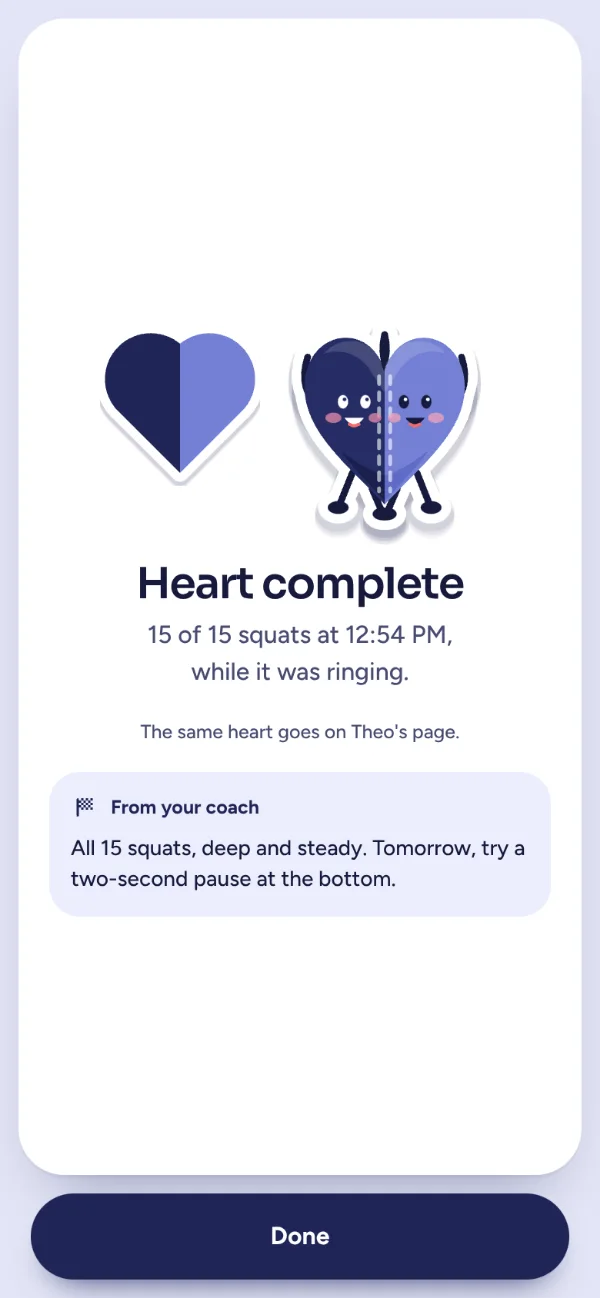
In Heartpact, each partner's finished dare is half a heart. When you both keep your word, the heart is whole, and a streak counts the days in a row.
Without an app, a paper calendar on the fridge with two pens works too. A tick from each of you is a small, visible way to say "we did that".
Review once a week
Set aside 10 minutes on the same evening each week. Ask three questions:
- What felt easy this week?
- What got in the way?
- What should we change for next week: the time, the exercise or the count?
Adjust one thing at a time. If the morning slot keeps failing, move it, rather than trying harder at a time that doesn't suit you. When the habit feels steady, you might try one of these fitness challenges for couples to add a new goal.
Heartpact also sends a weekly recap on Sunday evenings, a short look back at your hearts, dares and streaks with one suggestion for next week. It's a handy prompt for this conversation, but the talk itself is what matters.
If you don't share a home or a schedule
All of this works at a distance. Agree the same rules, set times that suit each of your days, and keep the check-in to one clear signal. If you're in different time zones, our guide to working out together long distance covers how to plan around the gap.
The point is the same wherever you are: two people, one small promise each, and a kind response when life gets in the way.
Questions
Can my partner really be my accountability partner for exercise?
Yes, and they often make a good one because they see your routine and care how you feel. It works best when you each make a promise, set the rules together and agree in advance how to handle missed days. That keeps it mutual rather than one person managing the other.
How do I stop accountability turning into nagging?
Move the reminder out of your partner's hands. Agree a fixed time and a single check-in, such as a one-word message or an alarm you both set up. Then nobody has to chase anybody.
What should we do when one of us misses a workout?
Ask what got in the way before assuming anything, and restart the next day without a speech. Avoid penalties like extra reps. If misses keep happening, change the time or make the promise smaller at your weekly review.
How small should our first fitness promise be?
Small enough to do on your worst day, ideally under five minutes, like 10 push-ups or a 30-second wall sit. The first couple of weeks are about the habit of showing up for each other. Add more once it feels easy, and check with a health professional first if you're pregnant, injured or unwell.